moldybluecheesecurds 2

Friday, April 30, 2010

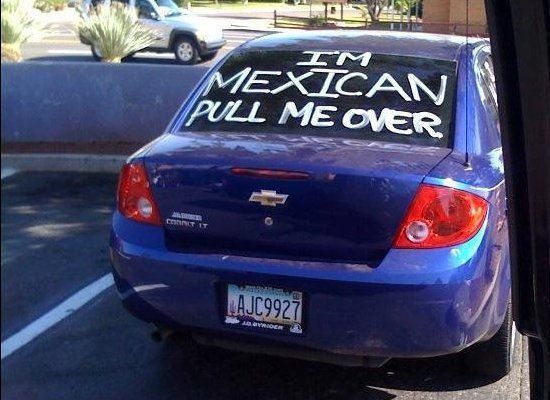
How to be an immigrant in Arizona

Arizona recently passed an illegal immigration law, summarized by the Economist:
Illegal immigration is a federal crime. Mr Pearce’s law, however, would also make it a state crime and would require the police, as opposed to federal agents, to make arrests and check the immigration status of individuals who look suspicious to them. Citizens who think their cops are not vigilant enough would be encouraged to sue their cities or counties, and no city or county may remain a “sanctuary” where this law is not enforced.

I think this image sums up the law even more succintly:

Drill, baby, drill


Need I note that when a wind turbine fails, it creates a much smaller mess?

Thursday, April 29, 2010

The dangers of putting your data in the cloud

This post is for CM.

Google has email and documents.  With them, your emails, documents, and spreadsheets are safely stored on their servers.  Better than having them on just one computer, have the hard drive die, and *POOF*  Right?

Perhaps not.  If your cloud-stored email is over 6 months old, did you know that the government can read it without a warrant?  This email is held to a lower standard by a 1986 law, that only "requires the authorities to make a probable-cause showing to a judge."  In a recent court case, the government was planning to assert it had that same right for recent emails, as well, but they decided they did not need them for their investigation. 

It's not just the issue of warrants, either, but of notification.  If the government wants to read your personal papers, they get a warrant, and you get to see it (and know they've taken them) because they bust down your door.  But if they want to read your email, they serve the warrant to your host (e.g. Google) and you'll never know they were there.  The FBI found this a very useful tactic when pursuing a couple spammers, getting access to their documents on Google Docs.

So cloud computing simplifies data backup and access to files, but it makes surveillance and government access to your data somewhat easier, as well.

Friday, April 16, 2010

Cool things I learned so far today

Gmail adds drag and drop file attachments.  w00t!

Lifehacker covers ways to skip to the menu on a DVD.  Can we finally be better off than when we had VCRs?

Guns That Look Like Toys

Baltimore Police Department:

I'll just throw this out there and see if anyone bites. Is there any legitimate reason that someone would want a gun colored to look like a toy? Channeling your inner Hello Kitty (Ak-47)?

Ugh.


Hat tip to Schneier

Thursday, April 15, 2010

Combo update: trash, tax breaks, assassination, internets, ok go, and hexane free food

Should the U.S. Burn or Bury its Trash?
A fascinating debate about the best strategy for our garbage.  I highly recommend the response by Neil Seldman of the Institute for Local Self-Reliance, who notes that incinerators aren't just lousy environmental choices, but are more expensive and provide fewer jobs than waste diversion like recycling.

Why are the Feds Giving Away $900 Billion in Tax Breaks a Year?
A good question.  David Morris asks why we should use the tax system for so many programs, where these tax breaks skew toward the wealthy.  For example, is it better to own a home if you are wealthy?  The mortgage interest deduction implies that it is. 

He notes that a quick fix would be making all tax credits and deductions refundable, so that they have equal benefit for all citizens.

President Authorizes Assassination of American Citizen
No, it's not President Bush, but Obama.  This U.S. citizen has clearly gotten involved in anti-American activities, but does that strip him of his constitutional rights to face his accusers and have a jury of his peers? 

How to Teach Kids about the Internet
Is a blog/diary private if its on the internet?  What information and ideas are wise to share online?  Kids don't see the internet as adults do, and teaching them about the risks is no easy task.
Raquel Kusunoki, a sixth-grade teacher at Spangler, recently asked Mr. Jenkins, now an educational technology specialist for the school district, to teach Common Sense classes to her students. The class listened as Mr. Jenkins read a story about a girl who got annoyed when her parents quizzed her about details from her online journal.

Mr. Jenkins asked the class if there is a difference between a private diary on paper and a public online diary. But the class could not agree.

Ok Go (the treadmill music video guys) are back.  And better.
See the new video and also a nice "making of" story at Wired.  Amazing.  Not to mention, also a cool song.

Does Your Veggie Burger Come with Neurotoxins?
A rather disturbing report about how best selling supermarket veggie burgers are often made using a petroleum byproduct, hexane. 

The good news?  You can avoid it, but it requires some label reading:
For hexane free food, instead look for Boca Burgers "Made with organic soy"; Helen's Kitchen; Morningstar "Made with organic"; Superburgers by Turtle Island; Tofurky and Wildwood.
Note: I don't think we should have to shop around for "hexane free food."   Read more at Mother Jones, and see the Cornucopia Institute report.

Wednesday, April 14, 2010

Quotes from George Will, born again nuclear enthusiast

In his most recent column, George Will seems to have discovered how nuclear power can save America.  Here's what else he's had to say about nuclear power:

August 30, 2004 (Charleston Daily Mail): "Often, an underpaid guard and a chain-link fence are the only security at the more than 130 nuclear reactors and other facilities using highly enriched uranium in 40 countries."


April 21, 2002 (Cleveland Plain Dealer): "the failure to solve the problem of waste disposal is one reason why no nuclear power generating plant has been built in a quarter of a century."

Other things George should keep in mind:
  • Unlike wind and solar, nuclear fuel is not free.  Uranium and plutonium will be more expensive once we stop getting free government fuel from dismantled arms.  
  • Based on capital costs alone, wind power is the same cost or less than new nuclear power plants.  And did I mention wind is free?
  • If he's so concerned about energy sprawl, why doesn't he worry about the fact that coal mines, natural gas fields, and uranium mines are "sprawled" all over the place, as are the rail and pipelines to bring them to power plants.  With wind and solar, you don't need fuel infrastructure, just power plants. 
Stick to heckling Democrats, Mr Will.

Monday, April 12, 2010

Exurban sprawl hits the wall of gas prices

StarTribune.com: "New estimates suggest that the movement into suburban and exurban counties within commuting distance of Minneapolis and St. Paul has stopped cold for the first time in recent memory."
Cheap energy made living on the urban fringe, if not desirable, but as gas prices rise, home values fall. The worst for a lot of folks is that now that they want to move closer in, their home values have fallen too much to make it possible. Ugh.

Friday, April 09, 2010

Apple iWork Pages problem

Apologies to my regular readers, but I have a rather intractable computer problem and I'm hoping that by posting to the internet, I may find some help.

The Pages Problem
Here's the deal.  I use iWork's Pages document program for most of my reports at work.  In the past couple months, I routinely have a problem crop up where I can no longer switch objects (images, tables, text boxes) from floating to inline.  A secondary symptom is that I can no longer drag and drop items off the Dock.

Things I've tried:
  • Trashing the Pages preference files
  • Trashing the Dock preference files
  • Killing the Dock in Terminal: killall -Dock
  • Repairing disk permissions
  • Screaming, pounding my desk, searching Apple's support forums
A workaround
I can reliably solve the problem temporarily by logging out of my account.  The problem seems to crop up at random some time after I've been using Pages.

System Setup
OS X 10.6.3
Pages 4.0.3
MacBook Pro (late 2006)

Thursday, April 08, 2010

Wednesday, April 07, 2010

Dear Conservatives,

I don't believe that you hate poor people, the environment, or think that every big business should be able to do whatever it wants. No, I actually agree with the first part of this quote.

NYTimes.com: "On the right, people are for smaller government as a matter of principle — smaller government for its own sake. And so they naturally imagine that their opponents must be their mirror image, wanting bigger government as a goal in itself."

But that's not true. As a liberal, it's true I don't believe in the simple (or simplistic) principle of small government. But I don't have a goal of large government. Government simply needs to be as big as is necessary to ensure equal opportunity in education, universal health care, a secure retirement, a clean environment, and economic justice (among other things) for all its citizens.

Government doesn't need to be small, it needs to be effective.

Thanks,
-Moldy

P.S. Plus, that free market you like is really a creature of government.

Tuesday, April 06, 2010

Up Next: Financial Reform

Health care is a done deal and the immediate economic crisis has past (with years of recovery to come).  Next up for Obama and Congress is financial reform, which can be summed up as "how do we keep this from happening again."

The Plan
First, a look at the Obama administration's recommended financial regulation plan:
  1. Giving regulators more monitoring authority (like the Consumer Product Safety Commission for toys).  "If your mortgage is a choking hazard, the government will issue a warning or a recall."
  2. Financial firms must reduce their debt and hold more capital in reserve.  "If things go bad, there will be more money around to plug holes on the leaking ship."
  3. Government can seize collapsing firms.  "If it's a total SNAFU, we'll just take them over."
Obama has also endorsed two other ideas.  First is the so-called Volcker Rule, which would prohibit banks from trading for their own profit, as opposed to on behalf of their clients.  Second is a bank tax, which would help recover the cost of the last bailout and help prepare for the next.

The Problems
However, there's a fair amount of criticism (same article) that these new rules will fall short.  On #2, the administration (and Senate) is being fairly loose about actual numbers.  So it's not clear if debt-to-capital ratios will be clear enough, e.g. "do I have to have a 20% down payment or a 1% down payment?"

And #3 is also problematic if left to regulators, since the folks in charge of the financial system for this crisis clearly used too little of their authority.

The Volcker Rule has also drawn a lot of flak for being insufficient or misdirected (check out the great chart explanation).

The weakness and vagueness of the Obama plan is the heart of Paul Krugman's criticism (did I mention he's a Nobel-winning economist?):
The Dodd [Senate] bill is similar to my concern that it’s too Hellenistic and not sufficiently Roman: it sets up a system that will work fine if we have first-rate regulators, but doesn’t seem robust to the mediocrity that is all too likely to prevail, sooner or later. [emphasis mine]
Without good regulation, what will happen is what just happened.  In good times (the 90s), investment banks make obscene profits.  In bad times, investment banks get bailed out by the government.  This concept is called lemon socialism, and it basically means that you privatize profits and socialize risk.

The History
Before we get to the proposed fixes, the history is really relevant.  Before the Great Depression, the banking sector had a panic every decade.  Banks speculated with deposits, and people lost everything.  Boo.

The Roosevelt administration responded to the Depression forcefully, and its new regulations (the Glass-Steagall Act) created a fairly inflexible system of rules to keep banks boring.
  1. All deposits were insured (FDIC).  Bank runs stopped.
  2. Banks must be boring - no more speculating with deposits or underwriting securities. 
The rules worked and the financial sector was stable for 50 years.  But in the 1980s, the rules left banks with a competition problem.  Banks (with savings deposits) had competition from mutual funds.  And businesses started borrowing money in the bond market instead of from banks. 

Since banks couldn't expand their business portfolio to compete (until the 1999 repeal of Glass-Steagall), "shadow banks" (Goldman Sachs, Lehman Brothers, etc) rose up to fill the void.  They had none of the rules about reserve capital or speculation that regular banks did, so they made fabulous profits on borrowed money throughout the 1990s and early 2000s.  And then the financial crisis hit and they went broke.  Ooops! 

Because government regulations hadn't kept pace, the government was forced to bail out these financial buccaneers to keep the entire credit market from collapsing (this actually is a big deal, since many companies make payroll by borrowing for very short terms, like overnight).  When the shadow banks fell, nobody wanted to lend, and this was locking up the economy.

So, will the Obama Plan fix everything?  Probably not.

Fixing the Obama Plan 
Krugman describes the fix pretty well:
"So what the legislation needs are explicit rules, rules that would force action even by regulators who don’t especially want to do their jobs. There should, for example, be a preset maximum level of allowable leverage — the financial reform that has already passed the House sets this at 15 to 1, and the Senate should follow suit. There should be hard rules determining when regulators have to seize a troubled financial firm. There should be no-exception rules requiring that complex financial derivatives be traded transparently. "

Canada, for example, has a very large banking sector but with very strict limits (a debt-to-capital ratio of 20:1, whereas the shadow banks in the U.S. were at 30:1 on the eve of the financial crisis).  And Canadian banks have weathered the downturn much better than their American counterparts.


The flexible parts of the Obama plan don't have to be discarded.  As pointed out in the first article on the Obama plan, discretion can be important.  An illustration is the "Schumer box," a requirement for all credit cards offers requiring the company to display the interest rate and annual fee prominently.  Card companies quickly learned to hide their fees in a variety of ways that did not require disclosure in the Schumer box.  Regulators must have the authority to be similarly nimble.

The Politics

Ultimately, financial regulation is a political issue and the position of the major players if fairly predictable:
Well, how about John Boehner, the House minority leader? Recently Mr. Boehner gave a talk to bankers in which he encouraged them to balk efforts by Congress to impose stricter regulation. “Don’t let those little punk staffers take advantage of you, and stand up for yourselves,” he urged — where by “taking advantage” he meant imposing some conditions on the industry in return for government backing.

Barney Frank, the chairman of the House Financial Services Committee, promptly had “Little Punk Staffer” buttons made up and distributed to Congressional aides. 

These punk staffers may be the only thing standing between the taxpayer and another boondoggle of a bailout.  Time to get a button.
Monday, April 05, 2010

It's not about who has the kids

Grist: Last week there was a silly article I ran across discussing the environmental benefits of being childless. I think this this response strikes the right chord. Humans are social and tribal creatures, and we need children. Only in a fragmented society like the U.S. could we end up having a discussion of the cost of children.

"Only if we view ourselves as isolated consumers do we end up thinking that having a child or not is a competing choice, as if the question is, 'Who's getting the most for their money?' If we think of ourselves as parts of a human ecosystem -- a community -- such a question seems silly, akin to asking which is better, a tree or a meadow. The choice of whether to have a child or not is obviously significant for the person in question, but real communities should be able to incorporate, and benefit from, everyone, whatever their choices."

Tuesday, March 30, 2010

The cost of things

The first two are Bush tax cuts, the third is the Iraq War.  The last is the recently passed health care reform act.  Guess which one has "deficit hawks" worried...

A greener future with no kids?

I saw a post on Grist touting a new concept, GINKs (green-inclined without kids).  The implication is that every new person is a carbon-emission-creating burden on the planet. 


Good for GINKs, but I prefer to raise a voter to counterbalance birthers, climategaters, etc.  They aren't forgoing children.

Art of the Steal: On the Trail of World’s Most Ingenious Thief | Magazine

Wired:Magazine:
"Blanchard pulled off his first heist when he was a 6-year-old living with his single mother in Winnipeg. The family couldn’t afford milk, and one day, after a long stretch of dry cereal, the boy spotted some recently delivered bottles on a neighbor’s porch. “I snuck over there between cars like I was on some kind of mission,” he says. “And no one saw me take it.” His heart was pounding, and the milk was somehow sweeter than usual. “After that,” he says, “I was hooked.”"
A fascinating tale of a high-tech thief who was finally rounded up by a couple Winnepeg cops. Reminds me of Catch Me If You Can.

Saturday, March 27, 2010

The Case for Teaching Less Math in Schools

Psychology Today: A fascinating article on the dangers of teaching kids math by rote, without the context for using it.

In an article published in 2005, Patricia Clark Kenschaft, a professor of mathematics at Montclair State University, described her experiences of going into elementary schools and talking with teachers about math. In one visit to a K-6 elementary school in New Jersey she discovered that not a single teacher, out of the fifty that she met with, knew how to find the area of a rectangle.[2] They taught multiplication, but none of them knew that multiplication is used to find the area of a rectangle. Their most common guess was that you add the length and the width to get the area. Their excuse for not knowing was that they did not need to teach about areas of rectangles; that came later in the curriculum. But the fact that they couldn't figure out that multiplication is used to find the area was evidence to Kenschaft that they didn't really know what multiplication is or what it is for. She also found that although the teachers knew and taught the algorithm for multiplying one two-digit number by another, none of them could explain why that algorithm works.

The article also describes an earlier experiment with teaching math, where a school deliberately did not give children much math instruction before grade 6. The lesson? Less is more.
"In sum, Benezet showed that kids who received just one year of arithmetic, in sixth grade, performed at least as well on standard calculations and much better on story problems than kids who had received several years of arithmetic training."
Crazy.

Energy Star Wars

Green Inc. Blog

Does this count as an air purifier? It does under Energy Star, and that's the kind of problem the program is having right now.

College to Save Money by Switching Email Font

Slashdot: "The school expects to use 30% less ink by switching from Arial to Century Gothic."

Wednesday, March 24, 2010

Republicans and anti-health care LAW tactics

The bill passed and the Party of No lost. But they've already sworn they will repeal the law, and state-based Republicans (legislators, attorneys generals) are threatening to sue on the basis that the health care bill somehow violates the 10th Amendment (powers not reserved for the feds reside with the states).

Unfortunately, the Republicans have uphill sledding in the repeal and legal world.
  • On repealing, Republicans have to either take over the House and get 60 seats in the Senate (mathematically impossible, I'm told) OR wait until 2013 and get control of both houses of Congress and the presidency.  Good luck with that.
  • On the legal appeals, Republicans are working against legal precedent when it comes to mandatory taxes, because the government already collects direct taxes (taxes such as Social Security and unemployment already exist).
  • Republicans are also going to have trouble with the insurance mandate itself, which can be seen as part of the broad reaching "interstate commerce" regulatory powers of the federal government.  And given that most insurance companies operate across state lines, good luck with that.
A nice quote from a story by Eric Black on the legal challenge:
Lucinda Jesson of Hamline Law School, said...“I would be surprised if it was taken seriously by the courts.”
The one thing I found worrying in Black's piece is that the federal government has been using the interstate commerce clause in some ways that seem like overreaching.  In California, for example, the Supreme Court struck down a medical marijuana law even though the law required it to be marijuana grown in California and not crossing state lines.  Even someone who grew there own, the Court said, could be subject to federal drug laws. 

The other interesting issue, he notes, is that states have become largely dependent on federal aid for many areas of spending (transportation, health care, etc) and that state discretion has largely vanished because the courts give broad latitude to the federal government to tie strings to its aid.  (Example // you want federal highway money, raise the legal drinking age...)  In an era of state dependence, the 10th amendment becomes almost meaningless.

I think that the health care bill is a very good thing for society, and I'm glad it's likely to stand against the legal challenges.  But it's interesting to consider how important states rights are in this era...